Maths at Hillstone
Our aim is to equip all pupils with the skills and confidence to solve a range of problems through fluency with numbers and mathematical reasoning.
How it works
Children are encouraged to see the mathematics that surrounds them every day and enjoy developing vital life skills in this subject.
Carefully planned activities encourage children to work mentally, observe patterns, make predictions and discuss relationships. Mathematics skills are also used in other subjects such as science, computing and art.
Quick Jump To Links

Mastering Maths at Hillstone
Mastering Maths at Hillstone
At Hillstone Primary, we have adopted a mastery approach in order to deliver the three aims of the National Curriculum, fluency, reasoning and problem solving. Underpinning this pedagogy is a belief that all children can achieve in maths. We believe in promoting a sustained and deep understanding by employing a variety of mastery strategies, with teaching for conceptual understanding at the heart of everything we do. We aim to create independent mathematicians who are well equipped to apply their learning to the wider world. Our approach aims to provide all children with full access to the curriculum, enabling them to develop independence, confidence and competence – ‘mastery’ in mathematics in order to be independent mathematicians who are well equipped to apply their learning to the wider world.
The mathematical journey that children undertake at Hillstone Primary aims to ensure that all pupils:
• become fluent in the fundamentals of mathematics, including through varied and frequent practice with increasingly complex problems over time, so that pupils develop conceptual understanding and the ability to recall and apply knowledge rapidly and accurately.
• reason mathematically by following a line of enquiry, conjecturing relationships and generalisations, and developing an argument, justification or proof using mathematical language.
• can solve problems by applying their mathematics to a variety of routine and nonroutine problems with increasing sophistication, including breaking down problems into a series of simpler steps and persevering in seeking solutions.
Key features of our curriculum include:
• High expectations for every child
• Greater depth of topics
• Real life number sense and place value
• Application of skills learn to solve problem
• Calculating with confidence– understand why it works
We place emphasis on the cumulative mastery of essential knowledge and skills in mathematics. It embeds a deeper understanding of maths by utilising a concrete, pictorial, abstract approach so that pupils understand what they are doing rather than just learning to repeat routines without grasping what is happening.

Early Years
Maths in EYFS
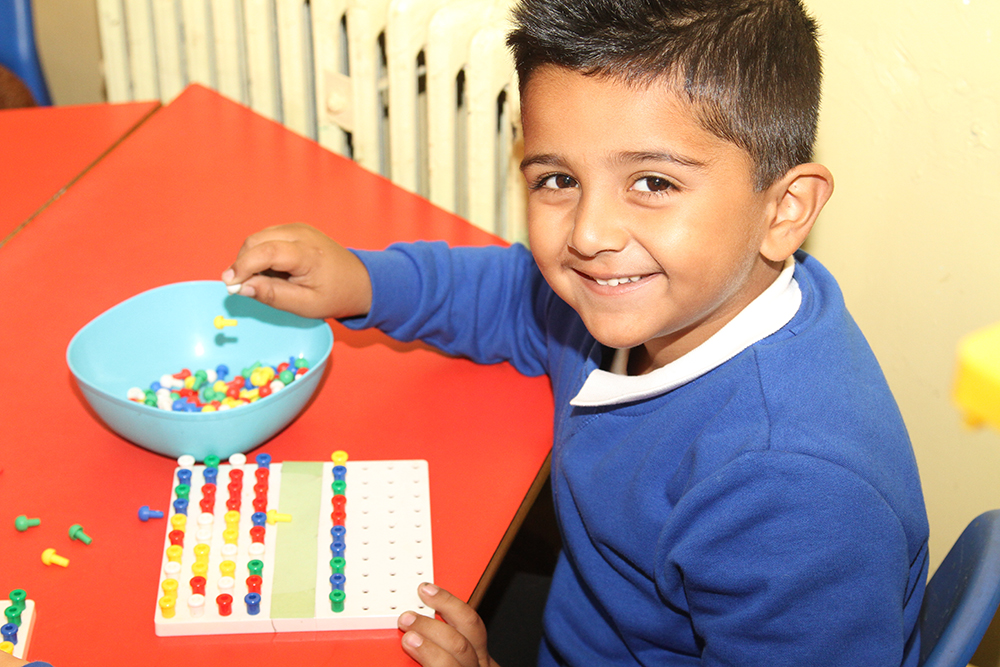
Maths in the Early Years is evident in daily activities, independent learning and taught sessions. Children are exposed to maths at all times and mathematical vocabulary and cross curricular opportunities are seized upon daily. Children use a range of concrete resources to explore maths practically. Subitising is a crucial skill that we aim to develop in the early years as this key area provides the roots for a child to become a competent and fluent mathematician. We are currently involved in the Mastering Mathematics project with the NCETM and Central Maths Hub, which aims to build up children’s subitising skills through a rich variety of activities (including Numberblocks) taught for ten minutes daily.

KS1
Maths in KS1
In KS1, we follow Maths No Problem, which is a scheme based on the Singapore approach to the teaching of mathematics. All children have a work book, textbook and a journal to complete maths learning. Lessons start with a problem which the children investigate as a class using concrete equipment. Children are actively involved in this and physically manipulate resources themselves to explore outcomes and investigations. When children have a secure understanding at a practical level, they move on to the pictorial stage of the lesson, where their learning is presented in different ways.
KS2
Maths in KS2
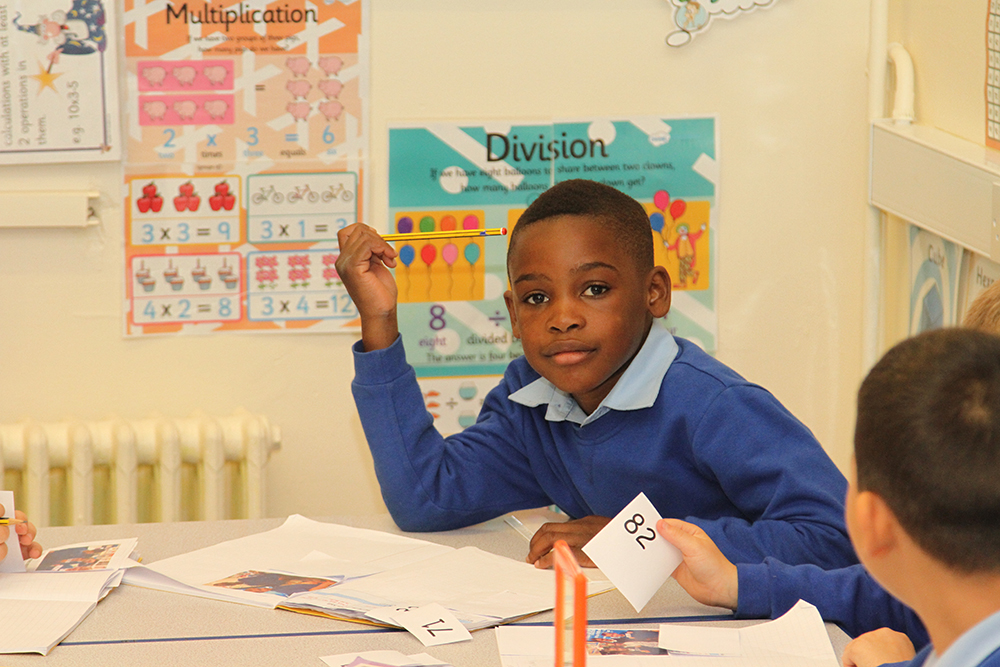
Maths No Problem is also followed in years three, four and five where lessons are adapted and crafted to meet the needs of our learners. Children are encouraged to show a range of journaling methods to show a deep understanding of a concept and then apply this new knowledge to a varied of problems. All children will be challenged, at their level, throughout lessons and effective use of assessment will ensure pupil progress.
In year six a variety of resources are used to ensure that high quality learning and mastery is taking place. We follow the medium term planning set out by the White Rose Hub but alongside this use resources published by the NCETM such as the mastery assessment materials and the reasoning guidance. Lessons follow a similar structure to years 1 – 5 and start with a problem or investigation which involves the use of concrete resources. In most lessons, children then demonstrate their learning pictorially before then completing the abstract tasks to develop the skills and show mastery of a concept

Mental Maths
Mental Maths
Children are encouraged to develop their mental maths skills every day throughout thecurriculum. We use Mastering Number resources to embed these crucial skills in the lower year groups and follow our KIRFs progression map throughout the school. Times tables are explicitly taught with facts broken down and introduced sequentially giving children the knowledge of what they actually are and how they are formed and also the opportunity to spot patterns and make links. The MTC test, taken in year four, is the result of a build up of these crucial skills in years one to four which form the bedrock of their mathematical journey.
Times Table Rock Stars is used not only to engage pupils in their maths learning through individual games and school competitions, but also to track their progress using the testing element and to plan and adapt lessons, and provide personalised targets, as necessary.
Target Tables are used to assess children’s fluency in recall and also their problem solving and reasoning skills. Focus Facts help children to break down the times tables into key pieces of knowledge and a deep understanding of inverses enables children to spot patterns and relationships.
Times Table Rock Stars is used not only to engage pupils in their maths learning through individual games and school competitions, but also to track their progress using the testing element and to plan and adapt lessons, and provide personalised targets, as necessary.
SEN
SEND
Personalised provision will be provided for children with SEND in maths. This may involve children spending a longer time on a concept or using concrete resources to aid understanding throughout the lesson.
In some cases, children may be working on objectives from previous year groups in line with their Learning Plan and Continuum sheets. Specific interventions may need to be planned for some children in line with the SEND policy.
Showcase